File / Person / Kenji Aoi Hoshino
Born on an island that became a museum.
i was born in 1991 on Naoshima, a small island in the Seto Inland Sea where the main industry for most of the twentieth century was a copper smelter, and where the land is still recovering from what was smelted there. I grew up under a sky divided between the chimney stacks that were being decommissioned and the museum that was going up on the hill above town, and if I try to explain where my interest in fictional architecture comes from, it comes from that. The industry left. The art arrived. The contaminated shoreline stayed.
I studied architecture in Osaka and then briefly in Tokyo, finished neither degree, and never worked in a building firm. What interested me was not the construction process but the image of a building before it exists: what a structure proposes about space and scale and the assumptions of a given moment. That interest eventually became literal. I now make images of buildings that do not exist and were never designed to, using AI generation tools as my primary medium. These are not concept renderings for projects under development. They are photographs of architecture that belongs to versions of cities that took different turns.
„i am clear about using AI as my primary generation tool."
„whether a building stands in Shimokitazawa or only in a rendered frame, what you are looking at is a proposal."
The practice took shape in Berlin, where I lived in Kreuzberg from 2015 to 2017, photographing and writing in a city whose language I had only studied in school. Something about working in that gap, between understanding and not understanding, changed how I approached documentation. I had been careful and deliberate in Japan, precise about framing and permission. In Kreuzberg I learned to move faster and trust the imperfect image, and I started writing architecture texts for a small publication that did not ask for credentials. When I came back to Tokyo in 2017, the writing continued and the photographic instinct had changed for good.
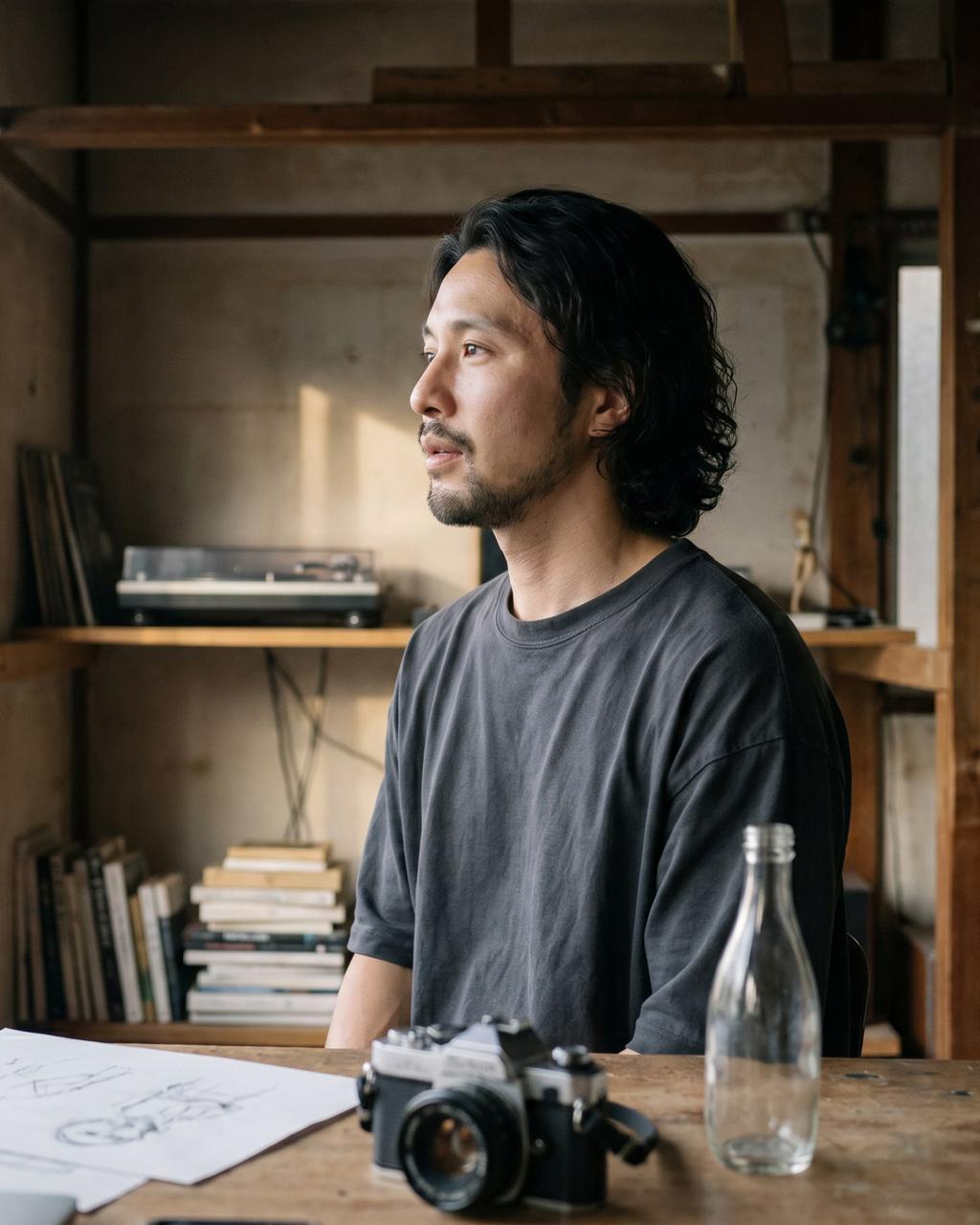
The studio is in a former workshop building two streets from my apartment in Shimokitazawa. The previous tenant was a metalworker, and on certain days, in certain humidity, the smell of machine oil still comes through the floor. I work there with a 35mm camera, a record player, and the tools for image generation. The work runs in five strands at once: fictional architecture produced with AI, a long observation series focused on Mount Fuji and its surrounding lakes in different weather, night photography from the streets of Shimokita and Koenji, early experiments in soundscapes for architectural spaces, and occasional essays and criticism for architecture publications. What is happening in one strand tends to change what is possible in the others.
The images I make look like photographs because I treat them as photographs: specific buildings in specific light, examined with the same attention I bring to a frame on 35mm film.