— work · 2026-05-17
Brass futaoki, Kuramae, 2024
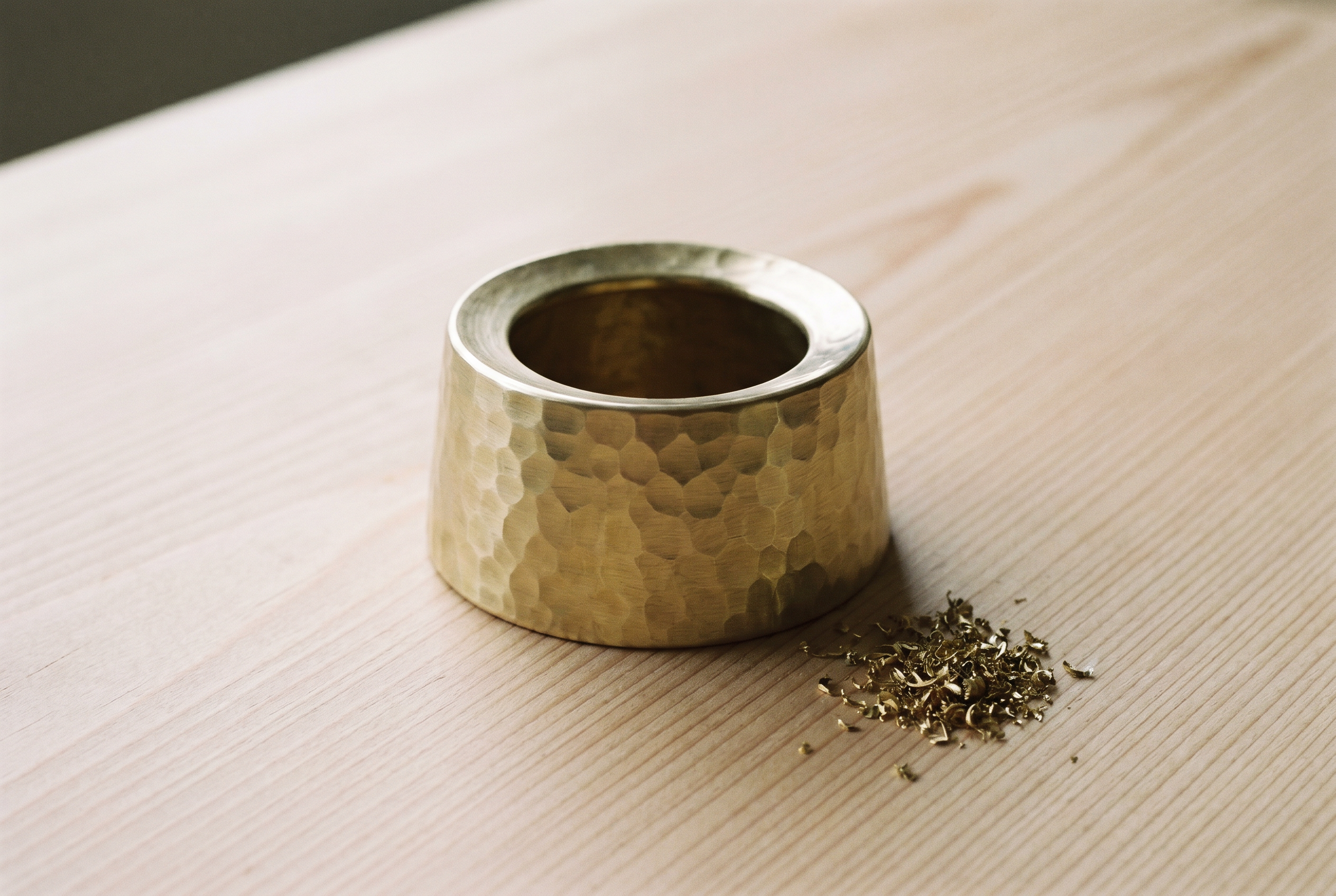
A small brass lid-rest, fifty millimeters across. Used in the tea ceremony to set the kettle lid down between pours. One of the smallest objects in the whole choreography. The brass is hand-hammered all over, about eight hundred strokes per piece, the facets soft and overlapping, a warm dull gold.
The maker is Reiko Andou. She is fifty-eight, runs a twenty-four square meter workshop in Kuramae, the eastern leather-district that has slowly turned into a small-craft enclave. She makes one object. Only this. She has made one object for ten years.
That is the part worth slowing down for. Andou worked twenty years as a senior art director in a Tokyo advertising agency before she opened the workshop in 2014. The thing she could not get past, she said in one of the rare interviews she has given, was that everything she had ever designed had been a product inside a magazine. Nothing she had made existed on its own terms outside the editorial frame. She wanted to make one object that her own hand held.

A futaoki takes six to eight hours. The brass is hammered against a leather pad on a hinoki workbench, with a small steel hammer she inherited from her father, who was a locksmith for old Tokyo merchant houses. Twelve to fifteen pieces a month leave the workshop. They go to three Tokyo shops and the museum store of the National Museum of Modern Art. Twelve thousand yen each. Andou does not sell from the workshop directly. The shop window only displays.
The argument under the object is the refusal of the line. The economics of small craft in Tokyo press hard toward product-line extension: if the futaoki works, add a chashaku spoon, add a kensui drain bowl, add a lid-rest in copper, add a seasonal variant, build a website, do a pop-up at a Daikanyama lifestyle shop. Andou has not. After ten years there is still just the one object, three hammer-finish grades, a fixed monthly volume. The line refusal is the practice, not just the product.

The workshop sits inside the ground floor of a slightly weathered concrete building, three meters of frontage, a single hand-painted wooden sign above the door. Most people walking past Kuramae do not stop. The few who do already know what they came for. The shop window is not a marketing surface. It is a quiet declaration that something is being made in here, today, by hand, at the same pace as last year and the year before.
The maker Reiko Andou, the workshop Andou Kanamono Kobo, and this specific brass futaoki design do not exist. The maker was invented for the design-objekt strand of this series. What exists is the gradual reorientation of Kuramae from leather industry to small-craft enclave over the last ten to fifteen years, and the observation that within that movement, some makers have built a practice around a single object and refused to extend it.