— work · 2026-05-17
Neighborhood library, Yanaka corner plot, 2020
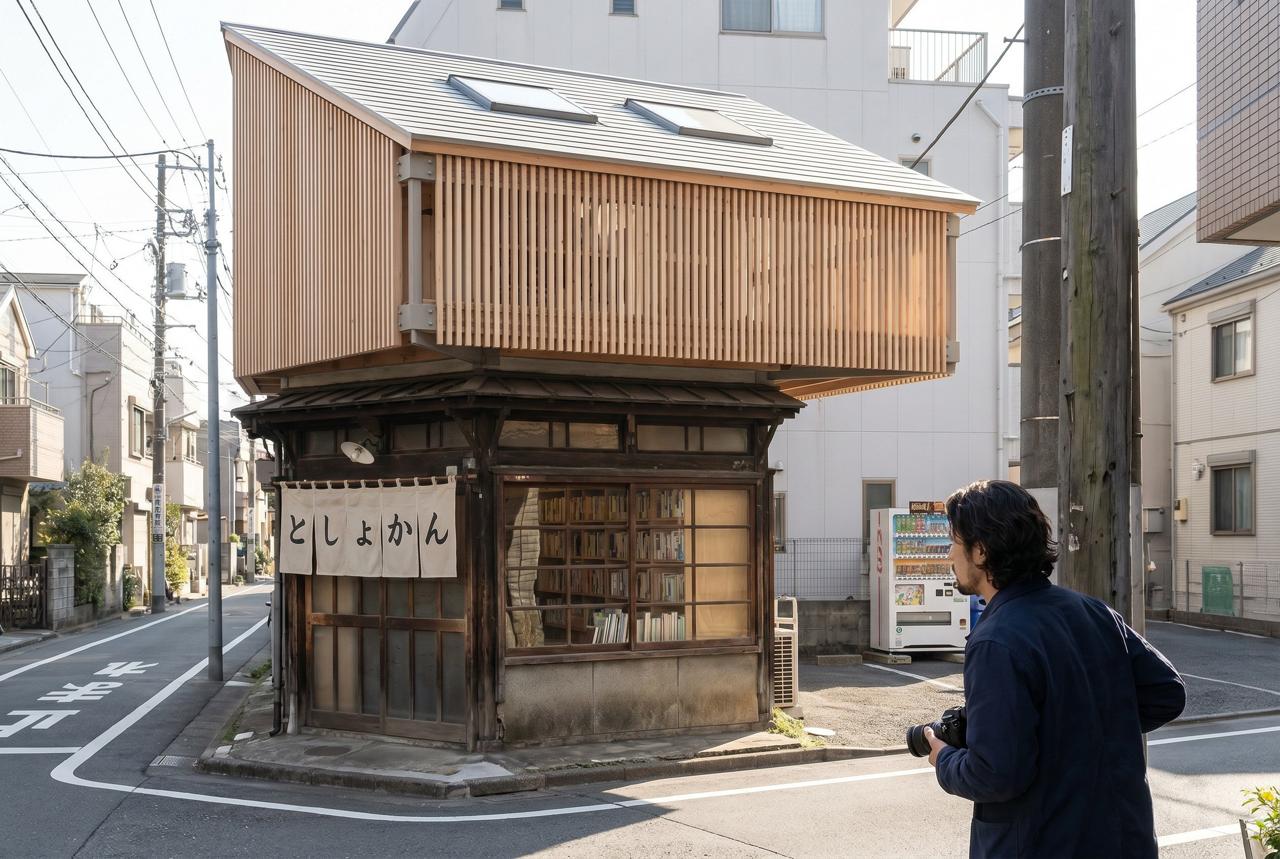
A small wooden corner building in the back-streets of Yanaka, built 1958 as a neighborhood izakaya, closed in 2018 when the owner died. Three small streets meet at the irregular almost-triangular plot. The neighborhood association bought the building. They wanted a library, small, low-threshold, not municipally funded.
This is what it looked like in 2017, still working as a tavern.

Two stories of dark stained cedar above the ground floor display window, three small paper lanterns hanging from the eaves, a hand-painted sign, a faded blue noren in the doorway. The owner inside, mostly silhouette behind the glass. One regular customer approaching, an elderly neighbor.
In 2020 Kosuge and Hama converted the building. The ground floor stayed: the old wooden bar counter is now the library check-in desk, the existing dark wood floors were sanded and left unpainted, the original wall beams are now visible. The walls are continuous shelves of poplar plywood, eighteen millimeters, three-ply, designed in the office and milled in a small workshop in Senju. Four thousand donated books.
The decision that makes the project is the upper floor.
The original second story was structurally compromised and had no use for the library program. They removed it. The original third floor was a small attic for laundry drying. They removed that too.
Where the upper structure had been, they built a new single upper floor in pale cedar lattice cladding. It cantilevers asymmetrically out over the ground floor. Four meters of overhang to the north, two meters to the west. The cantilever support is honest: warm-grey painted steel bracket-knots, raw industrial angle plates with visible M16 bolt-heads, structural and load-bearing, projecting outward from the old beams. The upper floor reads as a light wooden box hovering over the preserved old ground floor.
I stood partly behind a wooden electric pole. Wednesday morning, no readers yet inside, the door open. The shopkeeper from the souvenir place across the street watched me for about ten minutes before going back inside.
What the cantilever is doing
The asymmetric cantilever is not a flourish. It does three things at once.
First: a vertical strategy for adaptive reuse. The standard Tokyo adaptive reuse logic is horizontal: take an old facade, gut the interior, install new program at ground level. That works for retail and for small cafes but it tends to flatten the building into a graphic. Yanaka does not need more graphics. Kosuge and Hama work vertically instead: keep the old ground floor as old, build the new upper floor as new, let the two epochs visibly stack. The reader entering the library walks through the old izakaya volume and then climbs to a new wooden box. Two architectural moments separated by one staircase.
Second: a load reading. The old wooden post-and-beam structure of the 1958 izakaya could not bear a heavy new upper volume centered on its plan. But the post layout permitted a cantilever directed toward the corner of the lot, where the load could be reduced by extending over the sidewalks without a column going to the ground. The bracket-knots transfer the load back to the old beams at concentrated points. The asymmetry is a structural reading made visible, not a stylistic gesture.
Third: a trust gesture toward the neighborhood. The library is run by two retired schoolteachers, opened five days a week, eleven to nineteen, funded by donations and a small endowment from the citizens’ trust that bought the building. The cantilever extends physically over the public sidewalk. Not literally usable square meters but a generous gesture: the institution leans toward the street, not away from it. A library that cantilevers is a library that says we trust the neighborhood to keep an eye on us, and we are returning the gesture.

The detail of the bracket-knot, which I had to walk around the building to photograph because it sits at the eastern corner. Old weathered wooden beam in the lower half, the patina of sixty years of urban Tokyo weather. Pale new cedar lattice in the upper half, the warm wood of three years ago. Between them, warm-grey painted steel angle plates with bolt-heads showing, doing the structural work in public.
The library in Yanaka, the citizen trust that bought the corner plot, and the studio Kosuge + Hama do not exist. The studio was invented for this series. The library and the corner plot were invented for these images. What exists is the observation that Yanaka has resisted the tabula-rasa development pattern of central Tokyo through small acts of citizen-led adaptive reuse since the 1990s, that asymmetric cantilevers in small wooden buildings are a real and developing language in contemporary Tokyo architecture, and that the most interesting adaptive reuse interventions right now are the ones that work vertically rather than horizontally. The architecture I show is the version of that observation that would be there if it had been built.