— work · 2026-05-17
Sento extension, Akihabara back-streets, 2021
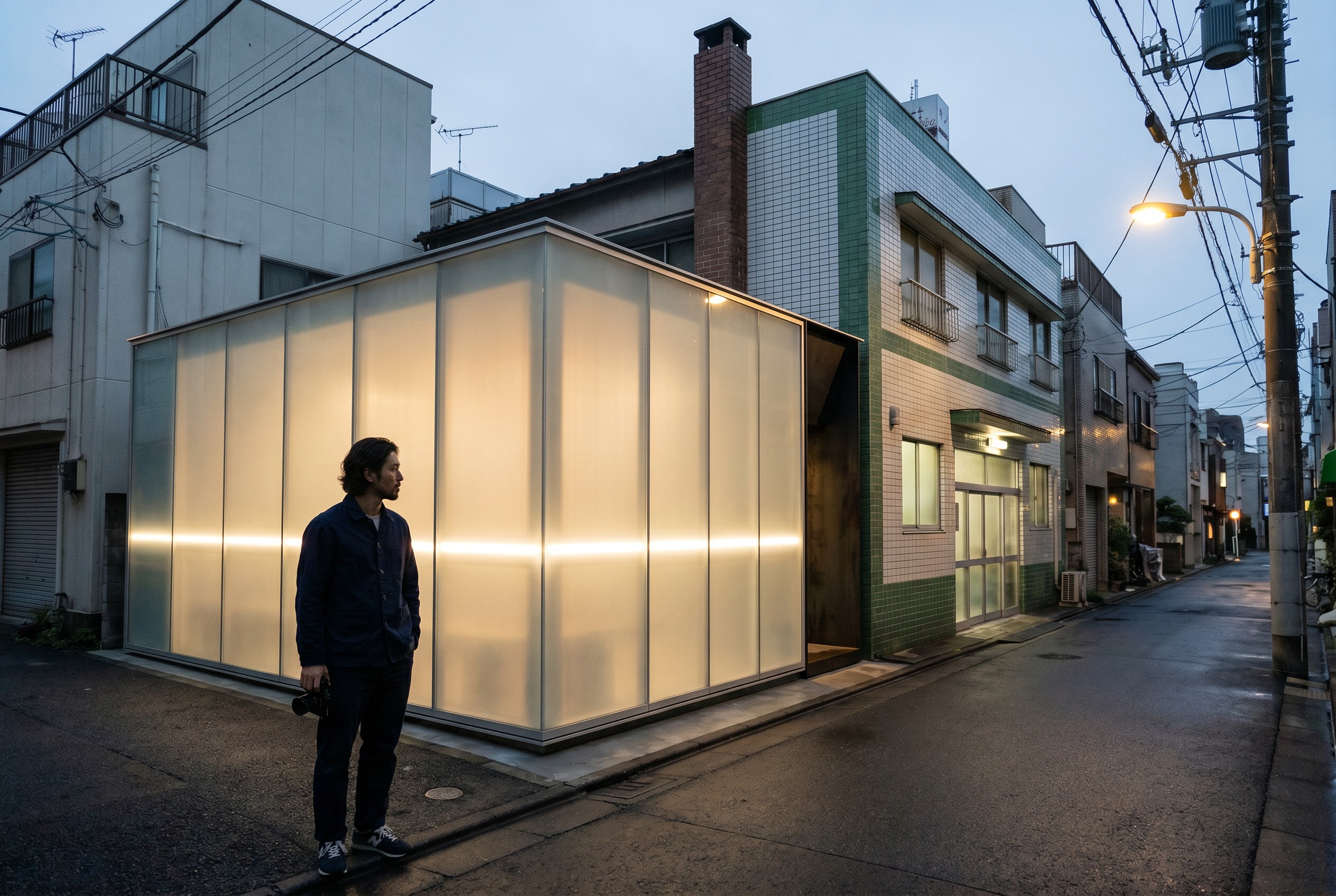
A small 1960s bathhouse in the back-streets behind Akihabara. Two stories, tiled facade, narrow chimney behind. It never became famous, but it never closed either. A rare line in Tokyo.
This is what it looked like before 2021.

Weathered tile, the noren in the doorway, a mailbox on a post in the empty lot to the left of the building, a faded poster taped to the side wall. Nothing on the north side yet. The women’s section inside was too small and had no daylight. People had been talking about that for a long time and nobody had done anything about it.
What Kosuge and Hama actually decided
The brief was small. The women’s section needed more volume and it needed daylight. The two obvious moves were both wrong.
The first wrong move would have been to renovate the inside of the old building: knock out a wall, take space from the men’s section or the central plant. That fails because the original 1960s sento is a fixed cubic logic. Take from one room and the other rooms collapse.
The second wrong move would have been to demolish and rebuild. That is the dominant Tokyo logic, sukura-and-rebuild, the same logic that has emptied half of the city’s neighbourhood texture since the bubble years. Wrong here because Inari-yu has a customer base of seventy regulars, mostly elderly, who walk to this specific door at this specific hour. A demolition closes the door for two years. Most of those seventy will not come back.
Kosuge and Hama’s move is additive. They leave the original cubic logic intact and set a single new volume against the north wall. Three by six by three meters. Floor-to-roof structural translucent glass. The old building keeps being itself. The new volume is honestly new. The seam between them, three centimeters of blackened steel, is not concealed.
The three theoretical positions stacked into the wall
The visible seam. The decision not to disguise the new as old, and not to disguise the old as new. Both stand as what they are. This is in the tradition of bauen im Bestand as it has been argued in European restoration practice since the 1970s, where the joint between epochs is read, not hidden. Hama studied at Tokyo Institute of Technology where this discourse arrives via translation, but Kosuge worked a year in Milan on adaptive reuse, where the discourse is native. Their position is that the joint is the project. Hide the joint and you have an imitation. Show the joint and you have a building with two truthful moments in its life.
The light-privacy paradox. Public bathhouses traditionally solved the daylight question with high clerestory windows, narrow slots cut into the roof. That works for men’s sections in old plans (where the bath is large and ceilings high) but fails for the small women’s sections of postwar sentos where the room is too narrow for the slot to reach the floor. The translucent multi-layered glass solves it differently: light enters through the entire wall but no figure or face crosses it. The bath is in the daytime. The body is invisible. The LED line at belly height is functional inside (wayfinding for elderly users in a wet room) and also softens the outside reading at night, so the volume is not a sudden lantern but a banded glow that suggests a horizon.
Defended infrastructure. Tokyo’s sento renaissance, real and ongoing since around 2010, is not a nostalgia project. The premise is that sentos are public infrastructure for housing stock that mostly still has bathing facilities too small to actually relax in. Older residents in particular need them as much as twentieth-century residents did. The architectural intervention does not romanticise the sento. It just keeps it functional, slightly improved, and visibly maintained. Kosuge and Hama explicitly position their work in this frame. The extension is not a gesture toward 1960s Japan. It is a gesture toward keeping the door open through to 2040.

The detail of the seam shows it most directly. Glass on the left, sixty-year-old tile on the right, the steel reveal vertical between them. The glass is recent, factory-controlled, dimensionally exact. The tile is hand-laid, mineral-stained, slightly off-grid. The steel does not lie about either of them.
Inari-yu, Akihabara, and the studio Kosuge + Hama do not exist. The studio was invented for this series. The bathhouse was invented for these images. What exists is the observation that the sento renaissance is happening in Tokyo, that bauen im Bestand has become a global discourse the last fifty years, and that extensions to old buildings ask the most interesting questions of scale and joint right now. The architecture I show is the version of that question that would be there if it had been built.