— work · 2026-05-17
Lawson reading nook, Suginami, 2023
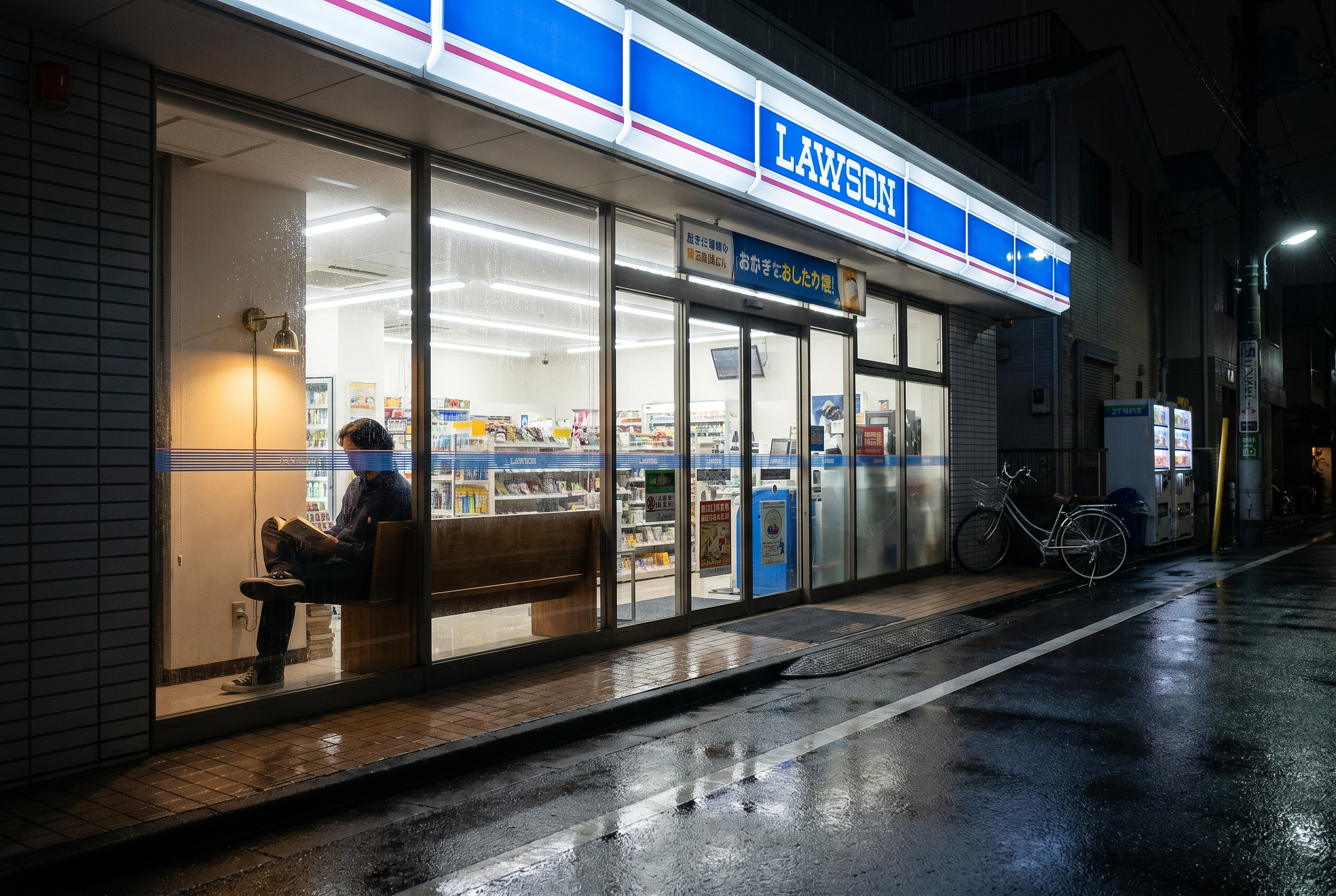
Suginami, March 2023. A 24-hour Lawson on a back-street, one of tens of thousands in Tokyo. In the front-left corner there had been a dead zone for years. Too close to the window for shelves. Too deep for a magazine rack. The kind of three-by-eighty corner everyone walks past without seeing.
Atsushi Mori, a solo architect, talked the franchise manager into letting him put a reading bench in. He paid the materials himself. Around 180,000 yen for cherry wood, a brass lamp, the steel fixings. Two weekends with a carpenter friend. Lawson supplied the wall.

What the bench does is small and precise. It removes you from the part of the konbini that wants to sell to you, without removing you from the konbini. You hear the same hot-water dispenser, the same automatic door, the same chime when someone enters. But the chair you sit on is not for sale, and it is not part of the dwell-time calculus. The light above you is warm, the rest of the store is cool. The difference of about ten minutes of reading is the entire architectural gesture.

Mori brought twelve books to the opening. The lower shelf now carries somewhere between sixty and eighty, donated by neighbors, taken by readers. Nobody checks. A handwritten card asks only bitte mitnehmen, bitte zurueckbringen wenn moeglich.
The argument under the bench is harder than it looks. The most interesting site for civic architecture in Tokyo right now is not the museum or the library. It is the konbini, the pharmacy, the karaoke-box, the small station lounge. These are where the city actually meets itself, every day, around the clock. Almost none of them have any architectural intelligence applied to them past brand-compliance fitouts. The bench is a small object, but the claim it makes is not small: that there is a civic register sitting unused inside Tokyo’s commercial infrastructure, and that the entry cost is two weekends and 180,000 yen.
It works because of a three-way agreement that nobody has signed. Architect: material and labor. Franchise: the wall and ongoing tolerance. Neighborhood: books and use. No contract. No branding. No sign on the door. The door is open twenty-four hours, the chair is free.
The Lawson branch, the architect Atsushi Mori, and his practice Mori Studio do not exist. Mori was invented for a series of micro-interventions in commercial space. What exists is the observation that Tokyo’s commercial infrastructure is one of the densest civic-contact surfaces in any city, and that almost nothing architectural is happening on it.