— work · 2026-05-18
The brick manifesto, seventy-one years on
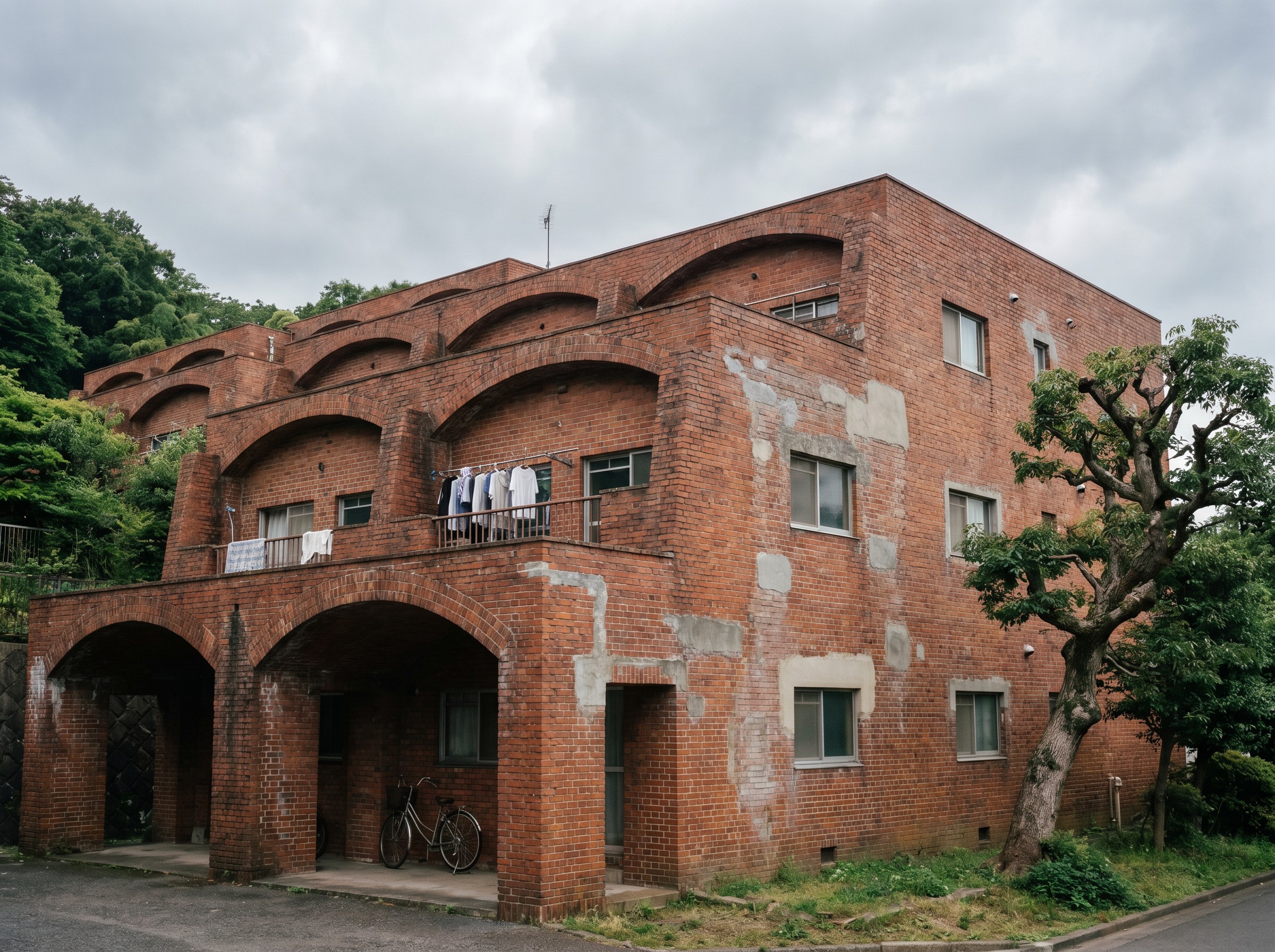
May 2026, overcast, twenty-one degrees. A soft diffuse afternoon, the kind that does not ask the brick to perform. Three of the five barrel-vault tiers seen from an oblique angle. No rake light, no drama, just the facade as it stands.
What does a manifesto building look like once the manifesto is no longer the news?
It looks like this. Laundry on a railing on the second tier. A bicycle leaned against the lowest arch pier. A tree, slightly tilted, grown into the corner over the decades. Repair patches in three mortar generations distributed across the entire facade like a quiet chronicle: the dark 1955 original, the lighter 1972 patches when the first crack survey was done, the pale grey skim from the 2010s. Nobody has restored anything. Nobody has tried to put the building back into the year it was made. The building has simply continued.
In 1955 this would have been the most polemical residential proposal in Tokyo. Thirty-two years after the Kanto earthquake destroyed more than half of the city’s brick buildings, thirty-one years after the 1924 seismic code essentially ended Japanese brick construction, a five-tier brick barrel-vault apartment block was not a design choice. It was a refusal of the consensus the catastrophe had settled. Brick belongs to the past. The arches belong to infrastructure. Residential bodies belong to wood and concrete.
The building holds the counter-position. Brick in residence. Arches as the first thought, not as the appropriated infrastructure of a later cafe enclave. The body in the curve, not against it. The only way to verify that the position was tenable was for the building to last long enough that nobody had to argue about it anymore. Seventy-one years on, the argument is just the address.
Overcast afternoon light does this well. It does not flatter the brick. It does not give the mortar patches the soft glamour they get in raking sun. It just shows the facade as a working surface, weathered, mended, lived in. Manifesto held.
The building does not exist. The work is part of the fiktive-architektur strand. What exists is the seismic history that ended Japanese brick construction in 1924, the rebuilding decades that followed, and the question of what other residential lineages might have been possible if a few projects had decided to argue with the consensus directly. The arch as a residential body, not as a borrowed infrastructure, is the proposition.