— work · 2026-05-19
Hatakeyama Reading Room, a library under the viaduct in Mukojima
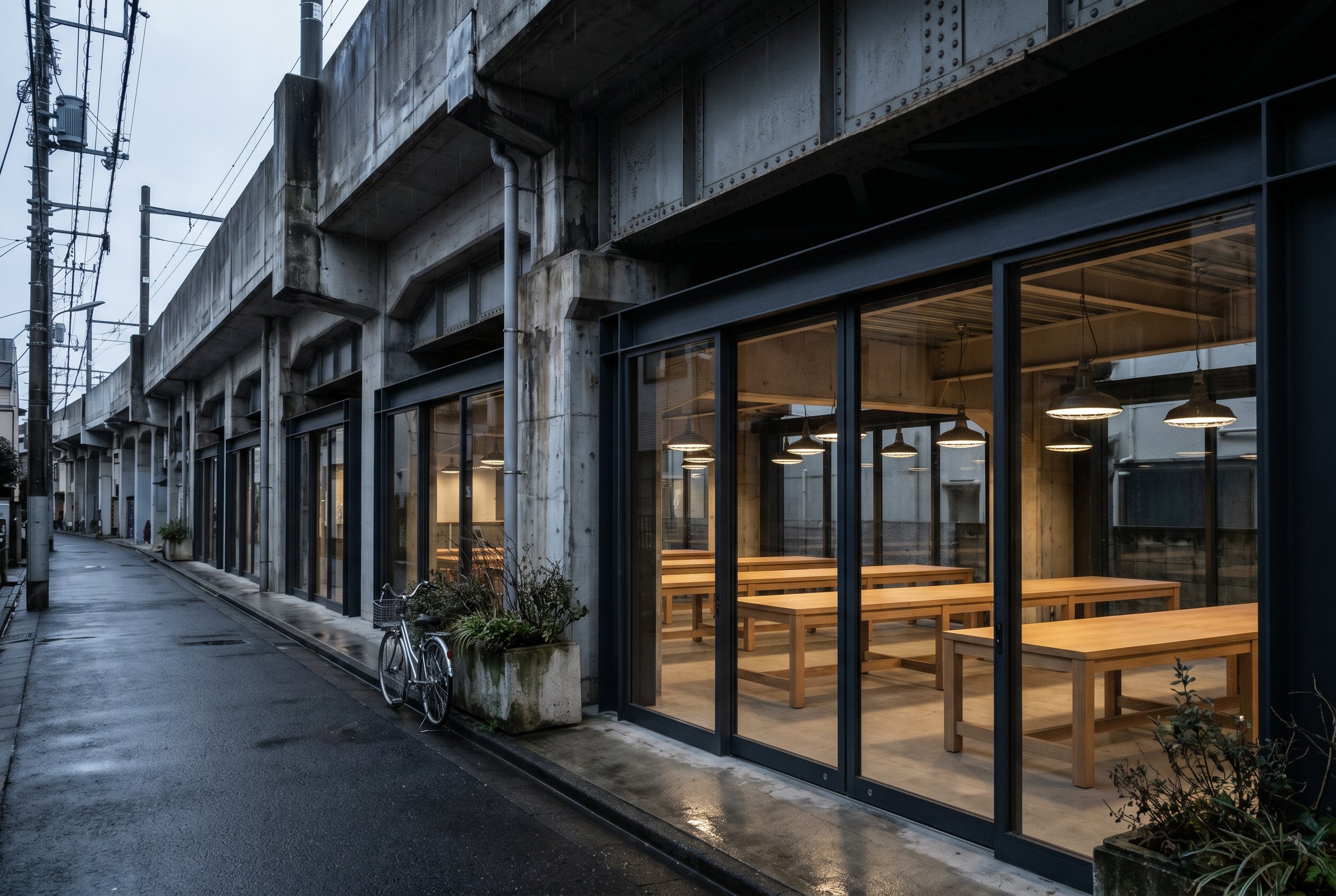
In Mukojima, on a side street two blocks east of the Tobu-Skytree line, there is a public reading hall built into the underside of the railway viaduct. It opened in 2019. The building is one hundred and forty meters long and seven meters deep, fixed against the line of weathered concrete piers that carry the trains east toward Oshiage. The ceiling of the reading hall is the underside of the viaduct itself: riveted steel girders, exposed, painted only in dark anti-corrosion grey.
The room holds six long pale-oak reading tables, ninety-six seats in total, low pendant lighting, and walls of low oak bookshelves that hold a circulating collection of about four thousand titles. The collection is run by the Sumida ward library system, which operates the reading hall as a satellite branch. Wifi is free. Headphones are required. The space is open from ten in the morning to ten at night, seven days a week.

The building has no architect’s name on it. It was funded by the Hatakeyama Foundation, a private civic-architecture trust based in Sumida-ku, which commissioned it as a contribution to the ward library system in 2017. The foundation does not require credit. The construction documentation lists the contractor and the structural engineer. The architect is recorded as “Sumida-ku public works architecture office, internal design”, which is how civic-anonymous buildings in Tokyo are usually filed.

What makes the building interesting is not the design. It is the proposition. A railway viaduct is an industrial infrastructure that produces shadow and noise along its length. The space under the viaduct is usually wasted, used for parking, vending machines, storage, or pop-up retail. The Hatakeyama Foundation made the case that part of this underused space, in a high-density residential ward with limited quiet study space, should be a free public reading hall.
The ward library system accepted the offer. The Tobu railway company leased the underside of the specific viaduct section to the ward for ninety-nine years at a nominal rent. The construction was kept simple. A full-height glazed front facade on the street side. A rear wall of insulated concrete panels against the back of the viaduct piers. Floor slab independent from the piers to isolate vibration. Acoustic absorption built into the ceiling cavities between the steel girders. Cost: about six hundred million yen, mostly absorbed by the foundation.

When a train passes overhead at full speed the room registers it as a low vibration in the floor and a soft bass tone in the ceiling. The vibration is felt rather than heard. People who study here for the first time look up and then go back to their books. People who study here regularly stop noticing.
This is what makes the building part of the larger shift in Tokyo. Re-tenancy as the conversion of underused civic infrastructure into a public-civic function. A train viaduct does what a train viaduct does. The reading hall is what fits under it. The two structures share a ceiling and ignore each other otherwise.

Six long tables. Ninety-six seats. A bass vibration every ninety seconds when the train passes east. A ward library card gets you in.