— work · 2026-05-19
Morning-glory railings, twelve houses in Asakusa 4-chome
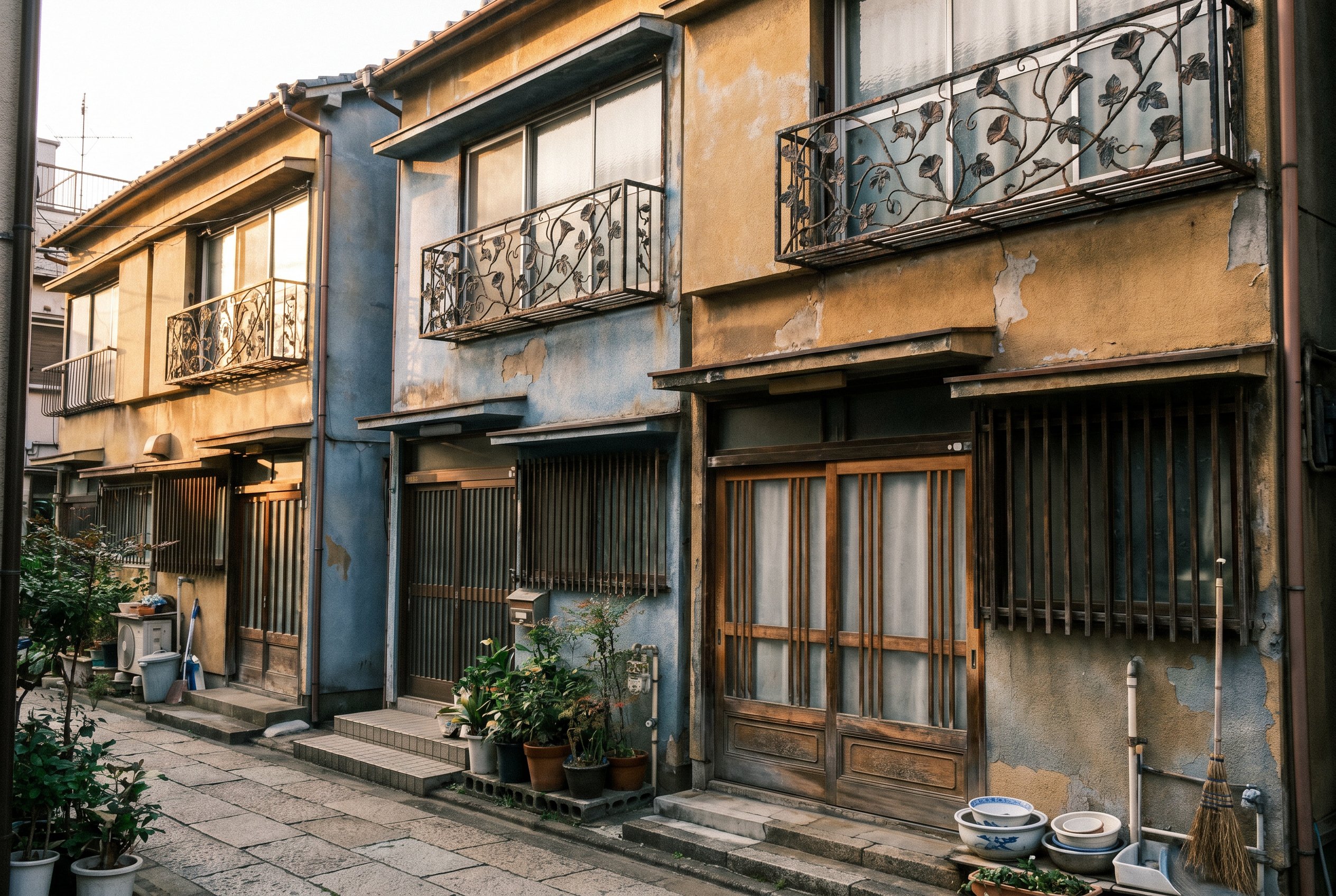
Two blocks north of Sensoji, off the main shopping streets, Asakusa 4-chome thins out into a quiet residential grid. The houses get older. Many are post-1945 rebuilds, but a handful are not. Narrow two-story rowhouses with stucco facades and sliding shoji on the ground floor, the kind of building that survived the firebombings because of how it stood between fire-walls. In this grid there are twelve houses that share one specific detail. Wrought-iron balcony railings on the second floor, all in the same morning-glory pattern.
The pattern is unambiguous. Curling vines cast in iron, three trumpet-shaped flowers per panel, leaves on alternating sides. The flowers are not stylized. They are recognizable as asagao, the morning-glory that opens at dawn and closes by noon, which has been the household flower of Edo and Tokyo summers for three hundred years. The pattern is somebody’s specific decision. It was cast, not bent. The work is too consistent to be free-hand.

The detail shows the actual ironwork. The vine is one continuous form. The tendrils curl back on themselves at the panel edges, suggesting that the cast was designed to repeat horizontally if more panels were needed. The flowers are convex, not flat. They project about two centimeters from the plane of the railing. They catch afternoon light from the side. From the inside of a second-floor room they read as silhouette against the street; from outside, in the right light, as relief.
The twelve houses are scattered through six blocks. They do not form a row. They are not architecturally identical except for the railings. Some have plastered facades in ochre, some in faded blue, two have been re-clad in vinyl siding from the 1980s and the railing remains attached to the new wall. The houses were not built as a set. They were retro-fitted with these railings at some point, most likely the late 1950s into the 1960s, the period of post-war ironwork that produced most of the surviving shitamachi balcony detail.

Whose work? An iron-shop somewhere in the postwar Taito district, probably already gone. The kind of operation that produced fence panels, gate hardware, balcony grilles and stove fittings out of one small foundry. The shop produced enough panels for twelve houses. Whether those panels were sold individually to twelve different building owners over a decade, or whether one builder ordered twelve sets and sold them as a package detail, is not known. The pattern survives in either case.

This is the substance of the observation. A specific ironwork pattern that does not exist in any catalogue, that was made by hand-built moulds in a single small shop, that ended up on twelve specific facades, and that is still there because the people who own the houses have not replaced their railings. Nobody has filed a heritage application. The pattern persists because nobody has decided to take it down.
A house ornament is a piece of cast metal that somebody screwed to a second floor and that nobody has unscrewed yet. The twelve houses in Asakusa 4-chome are the count.