— work · 2026-05-19
Setagaya Sonics, a basement that holds thirteen years
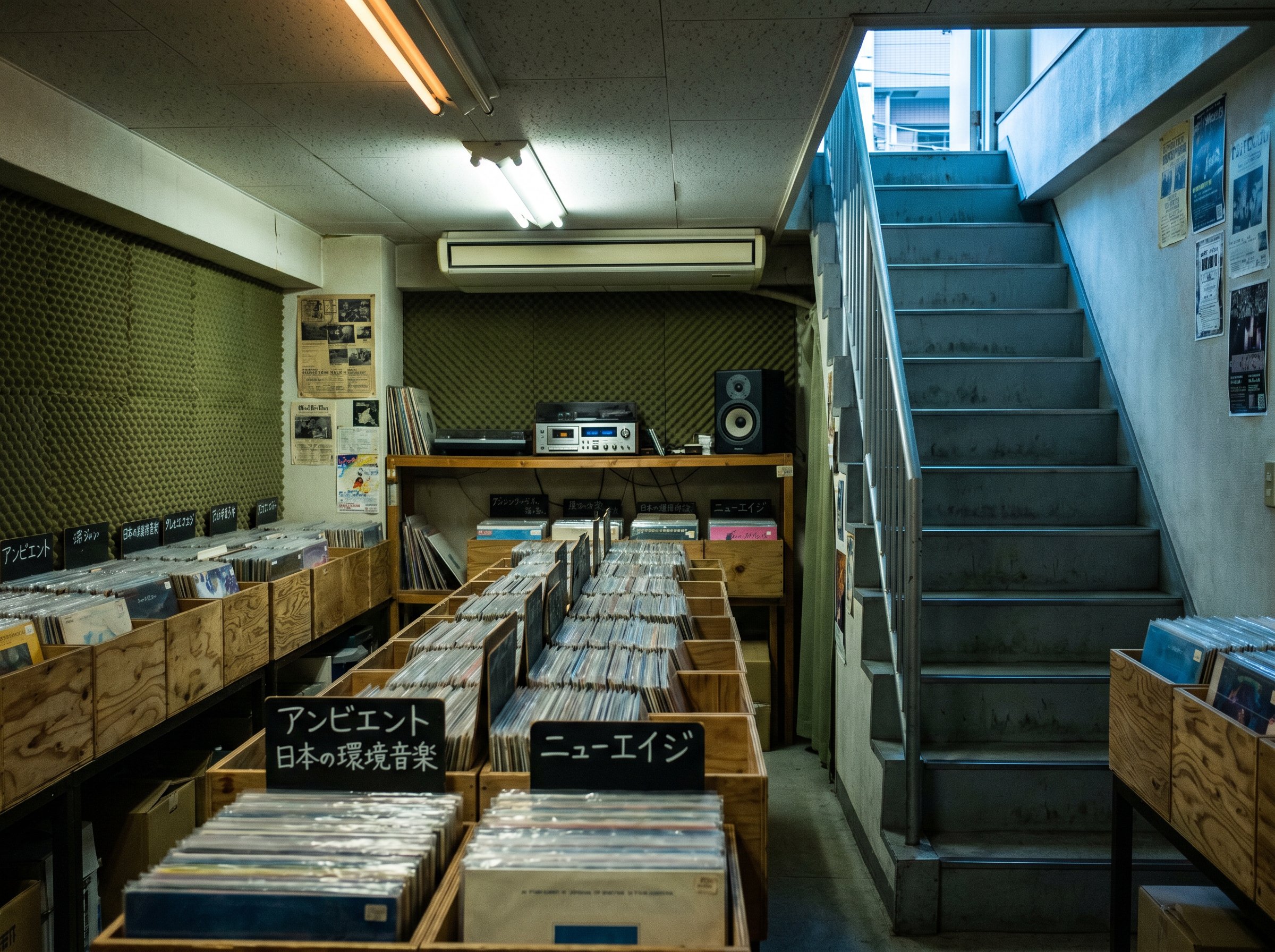
In Soshigaya-Okura, three stops west on the Odakyu line from where the houses get larger and the lots get older, there is a record shop that exists only in the basement of a five-story residential block. The street entrance is a single sliding glass door at sidewalk level with no signage, only a hand-cut piece of plywood about the size of a postcard that reads SETAGAYA SONICS in black marker. Behind the door, a concrete staircase descends ten steps to a single room of about thirty-five square meters.

The shop’s catalogue is one thing. From 1985 to 1998. Japanese ambient, environmental music, and library music. Nothing earlier. Nothing later. Nothing from other countries except a small import wall of European library music from the same period: German broadcasting library pressings, French production-music LPs, a few late Cherry Red and Sub Rosa releases that crossed over.
Thirteen years. One country. Two and a half genres. The whole shop is built on the proposition that this slice of recorded sound is rich enough to fill a permanent retail space in Tokyo.

The dividers tell the story. They are hand-lettered on plywood cards, eighteen centimeters wide, with black permanent marker. JAPANESE AMBIENT 1985-1998. ENVIRONMENTAL 1986-1994. LIBRARY (NHK-AFFILIATED) 1985-1991. MOOD MUSIC IMPORTS. SOUNDTRACK / GHIBLI-ADJACENT. NEW AGE / CROSSOVER. Each card is faded along the top edge where thumbs have moved through the rows for years.
What is interesting about the catalogue is not what it includes but what it refuses. There is no Hosono solo work from before 1984. There is no Sakamoto from the YMO years. There is no contemporary ambient revival, none of the recent re-issues that have made this music expensive on Discogs. The cut-offs are absolute. The owner has decided that what counts is a specific Japanese sound between two specific years, and everything outside those years belongs in another shop.

This is the substance of the place. A curatorial geography that does not apologize. Most Tokyo record shops are wide, with sections that drift into each other. This one is narrow and complete.
The technical evidence is in the room itself. Moss-green acoustic foam on the walls, mid-grade. A single Yamaha NS-10M near-field monitor on a shelf, never turned up. A restored Technics cassette deck on the back wall with the VU meters glowing pale orange. The lighting is warm fluorescent tubes from above, mixed with the cool daylight that drops down the stairwell from the sidewalk. The mix means the records on the upper crates look one color and the records on the lower crates look another. People who care about cover art reach down.

The shop is open four nights a week, eight to one in the morning. The owner does not run social media. The shop has no website. Discogs lists it as “active, no online sales”. To buy a record you have to be in Soshigaya-Okura late at night and willing to walk down ten concrete steps without knowing what is there.
Thirteen years. Three genres. One door at sidewalk level. The proposition is that some music is worth treating like an archive that opens after dark.