— work · 2026-05-20
Visiting a friend in Yamanakako
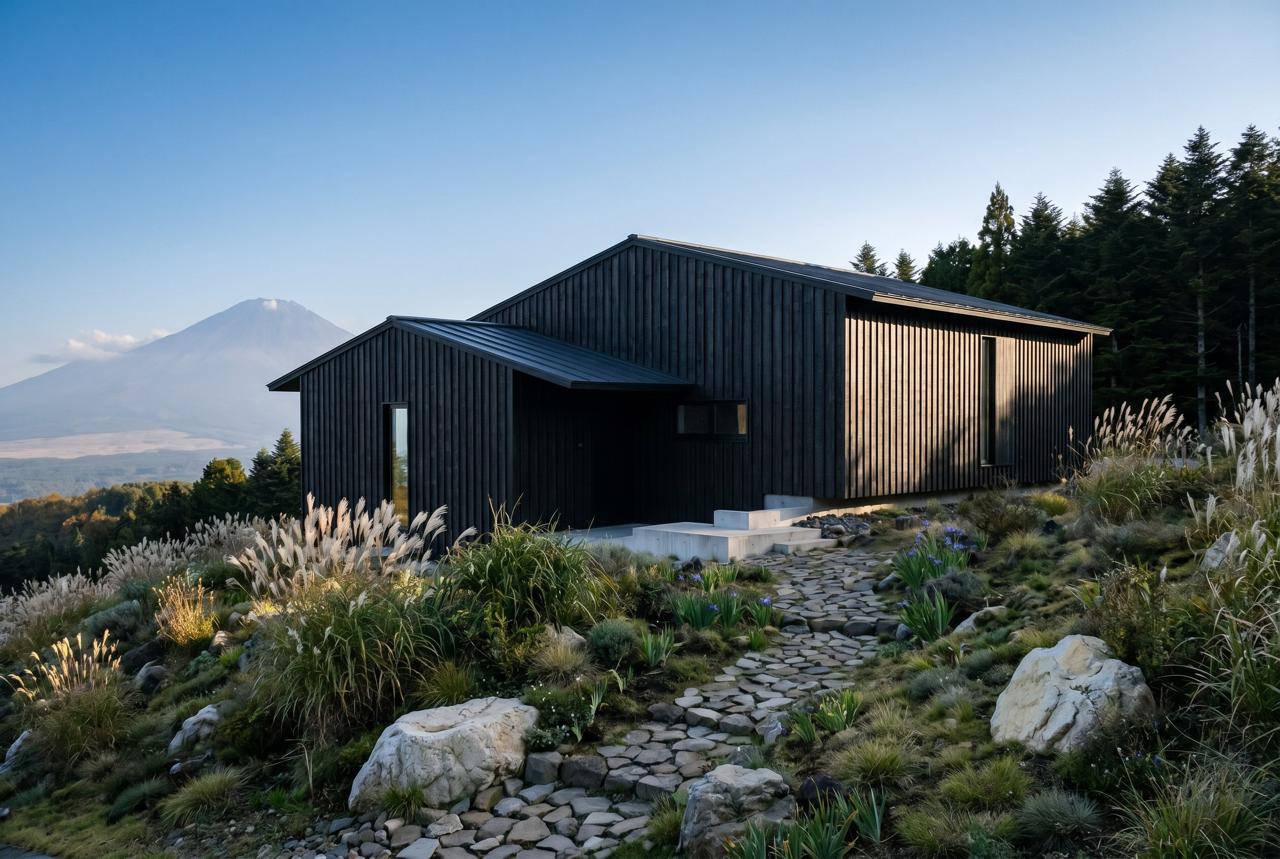
A friend has a house in Yamanakako, on a steep west-facing slope above the lake, with Fuji standing across the valley like a permanent fact. I went out to see him for a day.
The house sits low against the hill. Two volumes step against each other: the forward block higher and tighter, the main block lower and longer, sliding back into a spruce forest that holds the rear of the property. The roofs lean in two different directions. From the lake road below you read the house as a single dark mass against the trees. From the entry you read it as two pieces in slow conversation.
The cladding is Yakisugi, vertical, deeply charred, with the soft alligator-skin pattern that catches afternoon light without polish. Up close you can see the burn in the boards. He had it done in Shizuoka, the boards delivered by truck, installed in three weeks. Fuji is on the side, not behind the house. You see it when you arrive, he said, not when you sit. The mountain is not a postcard. It is geography.

The roof line is the part I had to look at twice. Two pitches that should not work together. They do.

The wood is the project’s whole register. Black, but not flat black. The boards run vertical, ten meters at a stretch on the long volume, the burn pattern reading differently in morning and afternoon light.

Below the entry the slope is steep. The path takes its time, large fieldstones with moss between them, irises already up at the lower edge, susuki coming in at the side. The irises surprised me for late May at this altitude.

Inside, a fragment. The light comes through the narrow slit on the gable, falls on the polished concrete, ends. The interior register shifts here, from the charred cedar outside to a calmer palette of white plaster, pale wood, and reflected light.

The living room takes that calmer palette out into full daylight. White plaster walls under an asymmetric pitched ceiling, a sharp diagonal of light coming through a small skylight at the ceiling joint, a black cast-iron wood-burning stove against the right wall on a low stone hearth, a full-height sliding door opening onto a Yakisugi deck. The furniture is restrained. A long hinoki bench with a small stack of books, a low pale-wood stool, a Technics SL-1200 on a low cabinet, one record sleeve leaning against it. The house insists on keeping the room quiet.

Walking back down the slope in the last hour of the day. The Yakisugi takes the warm light on the right flank, the spruce wall reads dark on the left, the path of fieldstones curves away under the susuki.

At the end I stood on the concrete podium with the X-Pro3. He was inside on the laptop, still talking about something I had stopped listening to. The slope was quiet. The mountain, off to the side, was being itself. I went home the same evening on the last bus.
The house in Yamanakako does not yet exist. The slope is cleared and the geometry is set, the spruce forest behind it stands, the friend is real. The volumes, the Yakisugi, the path with the irises, the concrete interior fragment, and the living room with the skylight and stove are transposed from the grey-shaded renderings on his laptop into the afternoon I spent on the site. The building will be there in a few years. The architecture I show is the version that would be there if it were.