— work · 2026-05-22
Tokio-Wohnbogen 1955, Phase 4, the folded depth
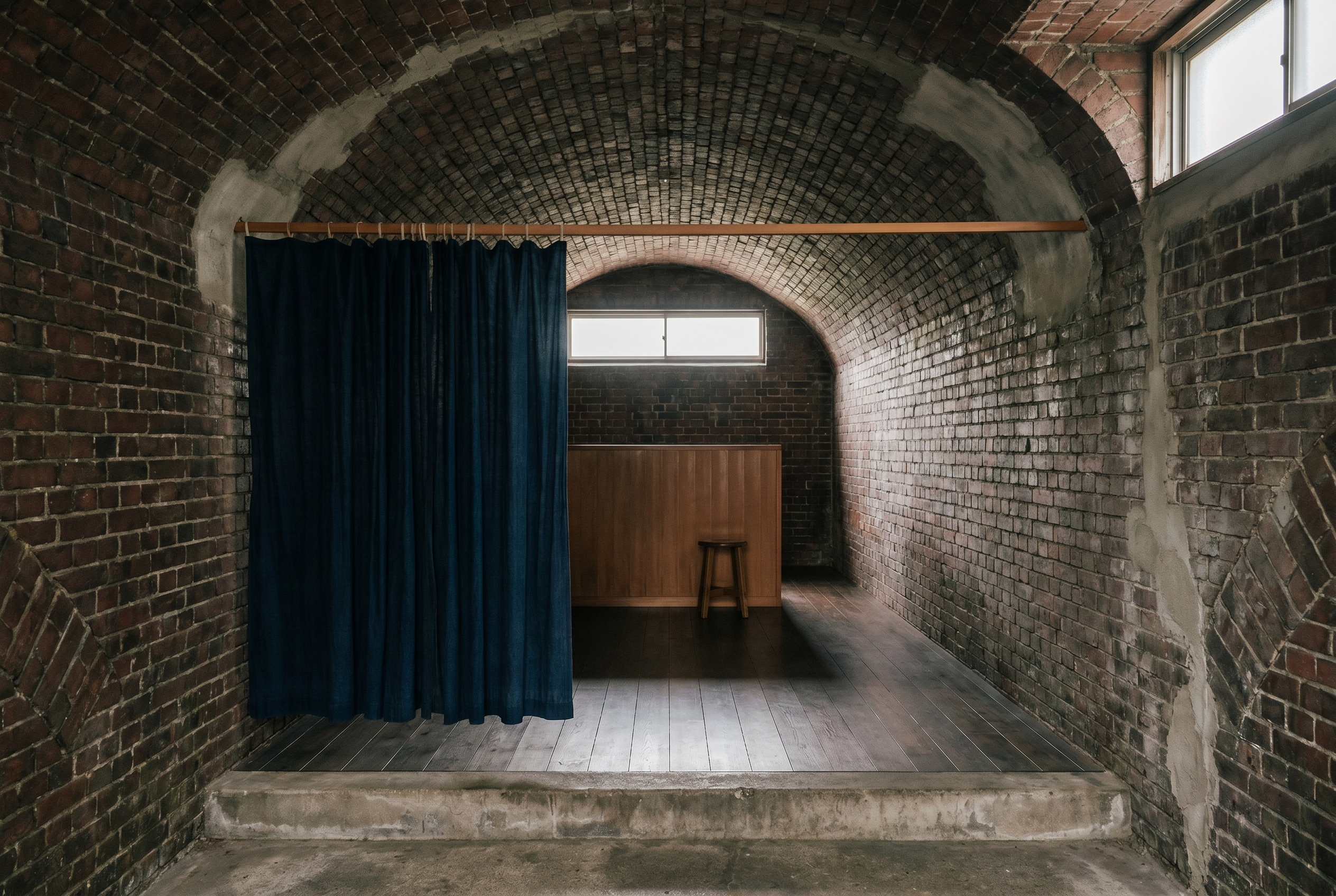
Three phases have read the Wohnbogen from outside. The manifest claim, the three-generation mortar chronology, the inhabited address in May 2026. What was missing was the depth.
Phase 4 takes Fumihiko Maki’s definition of folding from his Oku-Essay as a working condition. Oku is not the distance to a center. Oku is the number of folded thresholds between the entrance and the inner place. A library inside a temple complex is not farther from the street because more meters lie between them, but because more folds have to be traversed. Three thresholds are a different gesture than three meters.
The Wohnbogen has its depth-axis along the length of the vault. Four eighty wide at the springing, four twenty to the crown, as long in depth as the slope allows. That depth is not rendered here as a corridor. It is rendered as a sequence of folded thresholds.
First fold: a concrete step the full width of the arch, twelve centimeters above the entry level, the front edge worn smooth.
Second fold: a single heavy indigo curtain on a wooden rail at mid-height, the dark fabric reading as a horizontal band across the middle of the depth.
Third fold: a low hinoki partition just above sitting height, not full-width, with a single short wooden stool placed in front of it, half-blocking the lateral gap. The stool is the occupant of the fold.
Fourth fold: the light itself, entering from a small side window high on the right wall, raking diagonally across the brick vault. No window at the deep end. No view. The light enters laterally. The depth does not read as a tunnel.
Behind the fourth fold there is nothing more. No sanctum, no sightseeing point. Only the room ending. That is the point: oku does not lead to a value that justifies the folding. Oku folds because the folding itself builds depth. Maki writes this rather drily in the essay. Here it is seen as an image.
The work closes with this phase. A façade-end interior or a print- layout mock-up would be possible further phases, but either would destroy the oku reading. They would turn the depth back into a target.
The Wohnbogen does not exist in Tokyo. It is the manifest answer to the question what if the brick arch had been the first move in 1955, not the last after-the-fact retrofit of railway infrastructure. The inhabited façade, the three-generation mortar repair chronology, and the interior with its four folded thresholds are the only versions of the building that exist. Father’s copy of Maki’s Investigations in Collective Form sits in the café-room at Honmura with three bookmarks in the Oku-essay. Mine is in the studio.